
 ConesBulk pricing
 Hard HatsAdd your logo
 Hi-VisAdd your logo




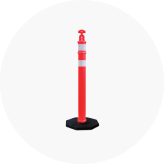




Choosing the right delineator posts requires matching the post type, height, color, reflective markings, base, and durability to the installation site. For temporary traffic control, portable orange delineator tubes with weighted rubber bases are common. For permanent lane guidance, surface-mounted flexible posts may be more suitable.
Before purchasing, buyers should also verify base compatibility, applicable MUTCD requirements, manufacturer performance data, and the total cost of installation and replacement.
This seven-step delineator posts buying guide helps contractors, municipalities, facility managers, and purchasing teams compare equipment without relying solely on product appearance or price.
Quick Answer: How to Buy Delineator Posts
Start by identifying where the delineators will be used. Then select the correct post style, dimensions, reflective configuration, and mounting system.
|
Buying factor |
What to check |
|
Application |
Roadwork, parking lot, warehouse, or fixed lane |
|
Post type |
Portable tube or permanent flexible post |
|
Height |
Visibility and applicable roadway requirements |
|
Color |
Orange, white, or yellow as appropriate |
|
Reflective material |
Band dimensions, placement, and performance |
|
Base or mount |
Weight, compatibility, and installation |
|
Durability |
Impact testing, material specifications, and approvals |
|
Quantity |
Required layout, replacements, and spares |
The Delineator Tubes collection includes grabber tubes, flat-top posts, tubular markers, and replacement rubber bases for different applications.
Step 1: Identify Where the Delineator Posts Will Be Used
The installation environment determines the most suitable delineator design.
Temporary work zones require devices that can be deployed and removed efficiently. Permanent traffic arrangements need mounting systems capable of remaining in place.
|
Application |
Practical starting point |
|
Temporary roadwork |
Orange tubular marker |
|
Parking lot |
Portable grabber or flat-top post |
|
Drive-thru lane |
Flexible post with suitable mounting |
|
Warehouse |
Portable weighted delineator |
|
Permanent lane separation |
Surface-mounted flexible marker |
|
Special event |
Portable post with weighted base |
Also consider traffic speed, wind exposure, lighting, vehicle contact, snow removal, and available installation space.
Delineator posts provide traffic guidance, not vehicle-impact protection.
Step 2: Choose the Right Delineator Post Type
Several designs serve different operational needs.
Portable Delineator Tubes
Portable tubes use weighted bases and can be repositioned without permanent pavement alterations.
They suit temporary construction zones, parking facilities, and events.
Grabber and Looper Posts
Grabber posts feature molded handles that simplify carrying and placement.
Some designs accept compatible accessories, including chains or warning devices.
Flat-Top Delineators
Flat-top posts provide a conventional upright marker without an integrated handle.
They may be appropriate where accessories and frequent manual repositioning are less important.
Surface-Mounted Flexible Posts
Surface-mounted posts attach to pavement using approved adhesives, anchors, or mechanical fasteners.
They are useful for fixed traffic guidance and selected lane-separation applications.
For a detailed explanation of these designs, see Types of Traffic Delineators: Tubes, Posts & Bases Explained.
Step 3: Select the Correct Height and Color
Delineator height affects conspicuity, while color helps communicate the intended traffic arrangement.
|
Post height |
Potential application |
|
28 inches |
Minimum height for certain highway and nighttime tubular marker applications |
|
36 inches |
Selected parking and facility guidance |
|
42 inches |
Portable work-zone and parking applications, subject to marking requirements |
|
45–48 inches |
Taller markers where increased conspicuity is appropriate |
These application examples are not universal height requirements.
Under MUTCD Section 6K.04, temporary tubular markers must be at least 18 inches tall and 2 inches wide facing traffic.
A minimum height of 28 inches applies to freeways, other high-speed highways, and nighttime highway operations.
Which Color Should You Buy?
Temporary tubular markers used for roadway traffic control must be predominantly orange.
For permanent roadway tubular markers, white reflective markings generally identify same-direction traffic separation, while yellow identifies opposing-direction separation.
Private facilities may use additional colors for internal purposes, subject to applicable rules.
Step 4: Choose Reflective Markings and Top Style
Retroreflective sheeting returns vehicle headlight illumination toward drivers, improving nighttime recognition.
The amount, position, and color of reflective material depend on the device and application.
For nighttime temporary traffic control:
-
Tubular markers shorter than 42 inches require two 3-inch-wide white reflective bands.
-
Tubular markers 42 inches or taller require four alternating orange-and-white retroreflective stripes, each 4–6 inches wide, with orange at the top.
These requirements come from MUTCD Section 6K.04.
A 42-inch post with only two white reflective collars should not automatically be considered compliant for nighttime public-road temporary traffic control.
Top style also matters. Grabber handles simplify transport, while flat-top or open-top designs may accommodate different manufacturer-approved accessories.
Verify accessory compatibility before ordering.
Step 5: Choose the Right Base or Mounting System
Base selection affects stability, installation effort, and replacement costs.
Portable Weighted Bases
Portable delineator tubes commonly use recycled-rubber bases.
Available commercial configurations include 8 lb, 12 lb, and 18 lb bases.
|
Base weight |
General purchasing consideration |
|
8 lb |
Lighter portable configuration |
|
12 lb |
Intermediate weight option |
|
18 lb |
Heavier configuration for applications requiring greater stabilization |
These are commercial choices, not federal minimum base weights.
The proper weight depends on the post design, manufacturer recommendations, weather exposure, and installation conditions.
Permanent Mounting Options
|
Mounting type |
Main consideration |
|
Butyl adhesive |
Surface condition and installation temperature |
|
Epoxy |
Surface preparation and curing |
|
Bolt-down base |
Pavement and anchor compatibility |
|
Replaceable anchor |
Post replacement after damage |
|
Embedded support |
Ground conditions and installation depth |
Permanent systems must use manufacturer-approved attachment methods.
Does the Base Come With the Post?
Not always.
Some listings include a complete post-and-base assembly. Others sell the tube and base separately.
Confirm the base opening dimensions, post diameter, brand compatibility, and whether the quoted weight is for the base alone or the assembled unit.
Step 6: Compare Durability and Performance Documentation
Delineator posts that look similar can have different material properties and recovery characteristics.
Portable posts often use polyethylene or related flexible plastics.
Some premium flexible systems use polyurethane or other resilient compounds designed for repeated contact.
However, material type alone does not establish durability.
|
Product category |
Typical design |
What to verify |
|
Economy portable |
Polyethylene tube and weighted base |
UV resistance, base fit, replacement parts |
|
Heavy-duty portable |
Reinforced flexible tube and heavier base |
Material specifications, stability |
|
Reboundable mounted |
Flexible post and approved mounting |
Published impact tests, recovery |
|
DOT-qualified mounted |
Agency-approved post system |
Approved-product listing and test documentation |
How Can You Verify Impact Resistance?
Request the manufacturer's test report identifying impact speed, vehicle or test equipment, number of impacts, temperature, and post recovery.
Some manufacturers publish repeated-impact claims, but those figures are model-specific and should not be applied to other products.
For example, the Texas Department of Transportation's DMS-4400 specification establishes qualification and testing requirements for certain flexible delineator and object-marker posts.
A product must be verified against the applicable agency's current approved materials list.
An impact-resistant post is not necessarily a crash-tested vehicle containment barrier.
Step 7: Calculate Quantity, Spares, and Total Cost
The number of delineator posts depends on the boundary length and approved spacing.
For a straight installation with a post at each endpoint:
Number of posts = (Length ÷ Spacing), rounded up, + 1
For example, consider a hypothetical 200-foot boundary with 10-foot spacing.
200 ÷ 10 = 20 intervals.
20 + 1 = 21 posts.
Adding two spare posts produces an initial purchasing quantity of 23.
The 10-foot spacing is illustrative, not a universal roadway spacing recommendation. Public-road spacing must follow the approved traffic control plan.
How Should You Compare Total Costs?
Calculate:
Total project cost = Posts + Bases or mounts + Installation + Freight + Expected replacements
A lower-priced post may cost more over time if frequent replacement or specialized labor is required.
Compare complete configurations rather than post-only prices.
What Documentation Should Buyers Request?
For contractor or municipal purchases, request documentation appropriate to the intended application.
Important records may include:
-
Manufacturer technical data sheet.
-
Post and base dimensions.
-
Retroreflective sheeting specifications.
-
Impact-test documentation, where relevant.
-
Applicable state DOT product approval.
-
Mounting and installation instructions.
-
Replacement-part availability.
-
Warranty and maintenance information.
MASH or NCHRP Report 350 documentation may be relevant to particular temporary work-zone applications. Verify whether the specific device and roadway authority require it.
Common Mistakes When Buying Delineator Posts
Purchasing problems frequently arise from incomplete specifications.
Common mistakes include ordering a post without its required base, purchasing incompatible replacement parts, or selecting a mounting method unsuitable for asphalt.
Other problems include:
-
Choosing reflective markings that do not match the intended roadway application.
-
Assuming heavier bases guarantee stability.
-
Treating manufacturer impact claims as universal certifications.
-
Purchasing permanent posts without confirming pavement compatibility.
-
Failing to budget for replacement components.
Product selection should reflect the actual installation rather than the lowest advertised unit price.
Buying Delineator Posts in Bulk
Bulk ordering can simplify equipment purchasing for contractors, public works departments, and facilities maintaining multiple installations.
Before requesting a quotation, specify the post model, quantity, height, reflective configuration, base weight, and delivery destination.
Government buyers should also confirm purchase-order procedures, tax-exempt documentation, and applicable contract requirements.
For large shipments, verify freight services, unloading equipment, lead time, and replacement-part availability.
Frequently Asked Questions
What height delineator post should I buy?
Choose the height according to the intended application and traffic control requirements. Temporary tubular markers must be at least 28 inches tall for high-speed or nighttime highway operations.
What color delineator posts do I need?
Orange is required for temporary roadway tubular markers. Permanent roadway applications use colors appropriate to traffic direction under applicable MUTCD provisions.
How heavy should a delineator base be?
Portable bases are available in different weights, including 8 lb, 12 lb, and 18 lb. Select a compatible model based on stability needs and manufacturer recommendations.
Do delineator posts come with bases?
Some products include bases, while others sell them separately. Review the exact selected configuration before purchasing.
How do I know whether a post is durable?
Check material specifications, manufacturer testing, UV resistance, mounting details, and any applicable agency approval.
Are all delineator posts MUTCD-compliant?
No. Compliance depends on the device's dimensions, color, markings, placement, and intended use.
Can flexible posts be installed on asphalt?
Yes, where a mounting system is designed and approved for the pavement conditions. Follow the manufacturer's installation requirements.
How many posts should I order?
Calculate the number required by the approved layout and spacing, then include a practical spare allowance.
How long do delineator posts last?
Service life depends on impacts, weather, UV exposure, mounting condition, and maintenance. There is no universal replacement interval.
Can delineator posts be ordered in bulk?
Yes. Buyers should request quantity pricing for the complete assembly and confirm freight, available inventory, and applicable purchasing terms.
Conclusion
Buying delineator posts requires more than comparing height and price.
Start with the intended application, confirm the required markings and mounting configuration, and review product durability documentation.
The best purchasing decision accounts for the complete assembly, installation conditions, replacement requirements, and long-term cost.