
 ConesBulk pricing
 Hard HatsAdd your logo
 Hi-VisAdd your logo


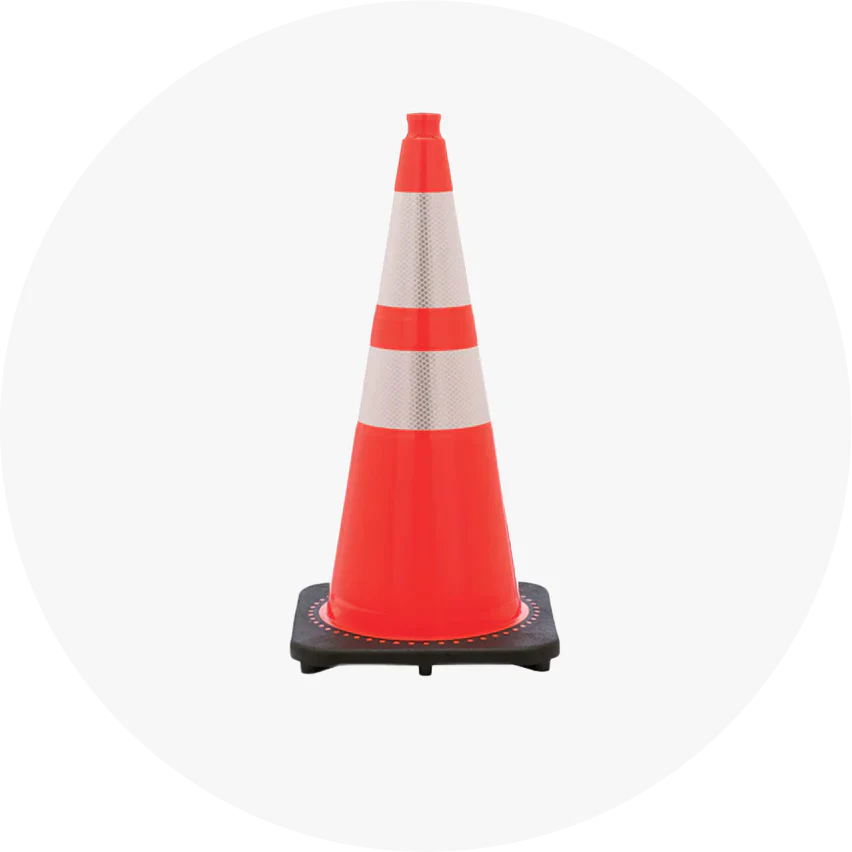





A 28-inch orange traffic cone with appropriate reflective markings is a common choice for roadway work zones, while smaller cones are generally suited to daytime, low-speed applications or private facilities. The correct cone depends on roadway conditions, visibility requirements, base stability, and the applicable traffic control plan.
Traffic cones are temporary traffic control devices used to guide vehicles, mark hazards, and separate traffic from work areas. They are commonly used during road construction, utility maintenance, emergency response, and parking operations.
However, cone height alone does not determine suitability. Reflectivity, material flexibility, ballast, and local transportation requirements also matter.
This traffic cone buying guide explains how these factors affect equipment selection.
Which Traffic Cone Do You Need?
The appropriate traffic cone depends on its application, operating conditions, and visibility requirements. Small cones can mark indoor hazards, while roadway applications generally require taller devices that meet the Manual on Uniform Traffic Control Devices (MUTCD) and applicable state standards.
|
Application |
Size to consider |
Key considerations |
|
Indoor training and sports |
6–12 inches |
Visibility and portability |
|
Private parking facilities |
12–18 inches or taller |
Vehicle movement and site rules |
|
Daytime, low-speed roadwork |
18 inches minimum |
MUTCD and local requirements |
|
Highway and nighttime work |
28 inches minimum |
Reflectivity or lighting |
|
Large or exposed work zones |
28–36 inches or taller |
Visibility, base stability, specifications |
The 18-inch and 28-inch minimums apply to the roadway conditions specified in MUTCD Section 6K.03. Smaller cones should not be substituted for required roadway devices.
Different Traffic cones are available with varying heights, reflective collars, base weights, and body designs.
What Are the MUTCD Requirements for Traffic Cones?
The MUTCD establishes national standards for traffic control devices used on streets and highways open to public travel.
The Federal Highway Administration (FHWA) publishes the manual. Section 6K.03 addresses traffic cones, including minimum height, color, material, and nighttime visibility.
Minimum Traffic Cone Height
For daytime use on low-speed roadways, traffic cones must be at least 18 inches tall.
On freeways, other high-speed highways, and highways at night, cones must be at least 28 inches tall.
The 28-inch minimum also applies when more conspicuous guidance is necessary.
These are minimum requirements, not universal recommendations for every site. State departments of transportation may specify taller cones or additional equipment requirements.
Required Traffic Cone Color
Roadway traffic cones must be predominantly orange.
Orange provides a recognizable temporary traffic control appearance that distinguishes work zone devices from many permanent roadway features.
Yellow, green, pink, and other cone colors may be used for specific activities on private property. They should not automatically replace orange devices where MUTCD requirements apply.
Reflective Collar Requirements
For nighttime roadway use, traffic cones must be retroreflectorized or equipped with lighting devices.
For cones measuring 28–36 inches tall, MUTCD Section 6K.03 specifies two white retroreflective bands:
-
A 6-inch-wide band positioned 3–4 inches below the cone's top.
-
A 4-inch-wide band positioned approximately 2 inches beneath the first band.
Cones taller than 36 inches require a different arrangement of alternating orange-and-white retroreflective stripes.
These requirements help drivers recognize temporary traffic control devices under vehicle headlights.
Traffic Cone Sizes Compared: 12, 18, 28, and 36 Inches
Traffic cone sizes determine their visibility and suitability for different environments.
Height should be selected according to the work area rather than convenience alone.
|
Cone height |
Common application |
Important limitation |
|
12 inches |
Warehouses, sports, training |
Below roadway minimums |
|
18 inches |
Daytime low-speed roadway work |
Not sufficient for specified nighttime or high-speed uses |
|
28 inches |
Road construction, utility work |
Must meet applicable visibility requirements |
|
36 inches |
Larger work zones and exposed locations |
Requires suitable base and markings |
12-Inch Traffic Cones
Twelve-inch cones are compact devices used for training, facility maintenance, and temporary hazard marking.
Their reduced height simplifies storage but makes them less conspicuous to approaching drivers.
They do not satisfy the federal minimum cone heights specified for roadway traffic control.
18-Inch Traffic Cones
Eighteen-inch cones meet the federal minimum height for daytime use on low-speed roadways.
However, a state transportation agency may require a taller cone.
Private parking areas may also use this size, depending on vehicle movement and site conditions.
28-Inch Traffic Cones
Twenty-eight-inch cones are widely used in construction and temporary traffic control.
They meet the minimum height specified for freeways, high-speed highways, and nighttime roadway operations.
Appropriate reflective markings or lighting remain necessary where required.
36-Inch Traffic Cones
Thirty-six-inch cones provide greater physical height than 28-inch designs.
They can be useful where additional visibility is desirable, subject to project specifications.
However, a taller cone does not automatically offer greater wind stability or meet every transportation agency's requirements.
Reflective vs. Non-Reflective Traffic Cones
Reflective traffic cones return vehicle headlight illumination toward approaching drivers. Non-reflective cones rely primarily on their visible body color and surrounding lighting.
This distinction is especially important during nighttime roadwork.
Retroreflective collars are commonly manufactured using engineered reflective sheeting. Their brightness, durability, and adhesion depend on the material and construction.
Collars can deteriorate through abrasion, repeated stacking, ultraviolet exposure, or improper storage.
For roadway use, select the exact reflective configuration required by the applicable traffic control plan.
Non-reflective cones may be appropriate for certain daytime operations, but their use must still meet relevant requirements.
How Heavy Should a Traffic Cone Be?
Traffic cone stability depends on base weight, footprint, cone height, wind exposure, and turbulence from passing vehicles.
The MUTCD does not establish one universal base weight for every traffic cone.
Common commercial configurations include 5.5 lb, 7 lb, and 10 lb bases, although actual requirements vary.
|
Base weight |
Typical consideration |
|
Lightweight base |
Easier handling in controlled environments |
|
5.5 lb |
Some portable 28-inch cone designs |
|
7 lb |
Common 28-inch roadway cone configuration |
|
10 lb or heavier |
Additional ballast for selected exposed applications |
These are product configurations, not federal weight classifications.
A wider base can improve resistance to tipping by increasing the support footprint.
For example, two cones with identical height and weight may behave differently if their base dimensions differ.
Check manufacturer guidance and agency specifications before selecting cones for windy locations.
Traffic Cone Materials: PVC, Rubber, and Polyethylene
Traffic cone materials influence flexibility, durability, weight, and response to temperature changes.
Manufacturers often combine different materials in one assembly.
|
Material |
Common function |
Characteristics |
|
Polyvinyl chloride (PVC) |
Cone body |
Flexible, resilient construction |
|
Recycled rubber |
Weighted base |
Adds mass and grip |
|
Low-density polyethylene (LDPE) |
Cone body |
Lightweight and flexible |
|
Polyethylene (PE) |
Molded components |
Properties vary by grade |
PVC is commonly used in flexible traffic cones because it can deform under contact.
Rubber bases provide ballast and help support the upright cone.
Polyethylene formulations vary in stiffness, temperature performance, and ultraviolet resistance.
Material names alone cannot establish service life. Manufacturer specifications and testing information remain more reliable.
What Are the Different Types of Traffic Cones?
Traffic cones differ in body geometry, storage design, reflective configuration, and intended use.
Common designs include standard wide-body cones, slim-line cones, collapsible cones, and mini cones.
Wide-body cones have a broader body profile and are commonly used for temporary traffic control.
Slim-line cones use a narrower body design that may simplify storage in service vehicles.
Collapsible cones fold into compact packages and are often used for portable warning applications.
Mini cones are typically used for sports, training, and facility marking.
To compare these types by application, see Best Traffic Cones for Parking Lots, Warehouses & Job Sites [related article link to be added].
Are Traffic Cones Crashworthy?
Traffic cone impact performance depends on material, construction, and the specific evaluation requirements that apply to the device.
The MUTCD requires roadway cones to be made from materials that can be struck without damaging the impacting vehicle.
This requirement does not mean cones provide positive protection against vehicle intrusion.
Some work zone devices may have crash-testing documentation associated with NCHRP Report 350 or the AASHTO Manual for Assessing Safety Hardware (MASH).
Any such claim should be verified for the exact product and configuration.
Traffic cones guide road users; they are not substitutes for crash-tested vehicle barriers.
How Many Traffic Cones Are Needed for a Work Zone?
The number of traffic cones depends on the traffic control layout, taper length, device spacing, and roadway conditions.
A lane closure typically requires an advance warning area, transition area, activity area, and termination area where applicable.
Cone spacing is determined from the approved temporary traffic control plan and relevant MUTCD guidance.
For example, a longer taper generally requires more channelizing devices when the specified spacing remains unchanged.
The total quantity must also account for repeated setups, damaged cones, and operational reserves.
There is no single cone quantity suitable for every roadway project.
What Should You Consider When Ordering Traffic Cones in Bulk?
Bulk quantities should be calculated from the number of work zones, equipment requirements, and expected replacement needs.
Compare cones using equivalent specifications rather than unit price alone.
Important variables include height, reflective sheeting, base weight, body material, and selling quantity.
For example, a 28-inch cone with two retroreflective collars is not directly equivalent to a non-reflective cone with a lighter base.
Storage capacity also matters. Nesting cones occupy less space than separate upright devices, but stack height and total weight affect transportation.
Record the specifications required for each project before estimating quantities.
When Should Traffic Cones Be Replaced?
Traffic cones should be replaced when damage or deterioration prevents them from functioning as intended.
Typical warning signs include faded body color, cracks, broken bases, and damaged reflective collars.
A cone that no longer stands upright may create confusion or become displaced by traffic.
Reflective sheeting also requires inspection. Dirt, peeling, and abrasion can reduce nighttime visibility.
Regular equipment checks help identify unsuitable cones before deployment.
Frequently Asked Questions
What size traffic cone is required for roadwork?
The MUTCD specifies a minimum height of 18 inches for daytime, low-speed roadway applications. Cones must be at least 28 inches tall on freeways, other high-speed highways, and highways at night.
Do traffic cones need reflective collars?
For nighttime roadway use, cones must be retroreflectorized or equipped with lighting devices. Where 28–36-inch cones use retroreflective markings, the MUTCD specifies a 6-inch white band and a second 4-inch white band.
Are 36-inch cones better than 28-inch cones?
Thirty-six-inch cones provide greater height, but that does not automatically make them better. Both sizes can serve suitable roadway applications when their markings, construction, and installation meet the relevant requirements.
How heavy should traffic cones be in windy areas?
There is no universal federal base-weight requirement. Stability depends on base dimensions, ballast, cone height, wind conditions, and passing traffic. Follow manufacturer guidance and applicable agency specifications.
Can collapsible traffic cones be used on public roads?
Collapsible cones should be used on public roads only when the exact model and configuration meet the applicable roadway requirements. Portability alone does not establish suitability for temporary traffic control.
Can traffic cones be used to reserve street parking?
Public streets are generally regulated by local parking and traffic authorities. Individuals should not assume they can reserve public parking spaces using traffic cones. Check local laws and obtain required authorization before placing devices.
Conclusion
Selecting traffic cones requires more than choosing a height or color.
For roadway operations, begin with MUTCD requirements, then evaluate cone height, retroreflectivity, base stability, materials, and the approved traffic control plan.
Twenty-eight-inch orange cones with the required nighttime markings are a common configuration, but each application must be assessed individually.
The correct selection balances visibility, stability, durability, and regulatory suitability.