
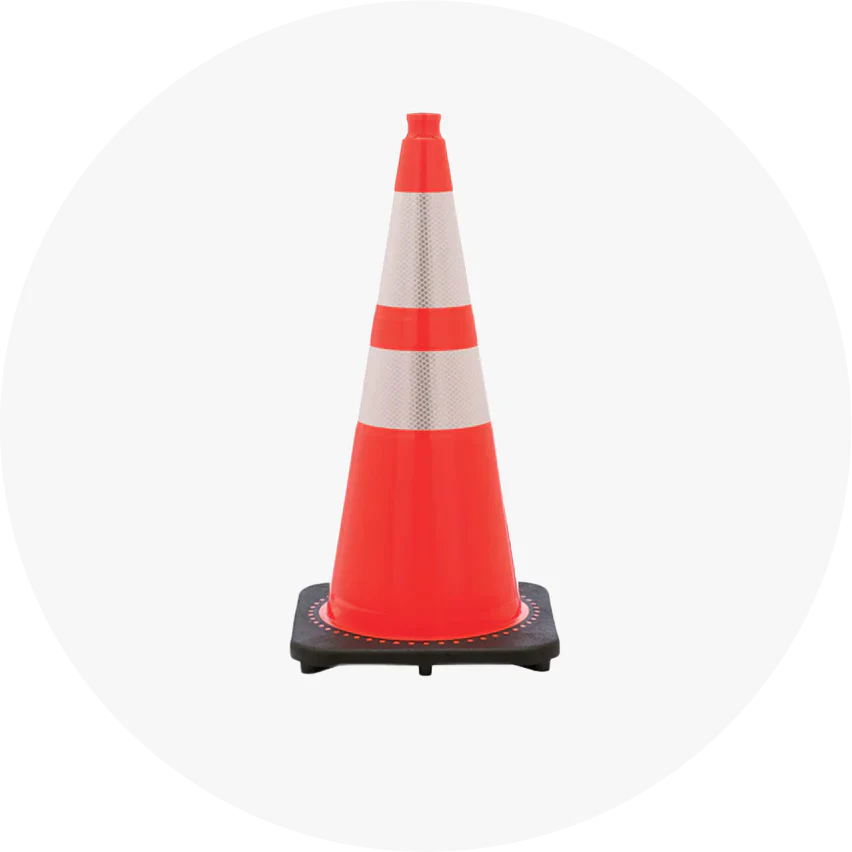

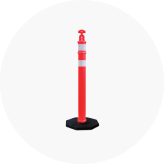




The best traffic cones for parking lots, warehouses, and jobsites depend on the required visibility, placement conditions, and traffic exposure. Small cones can mark training areas, while larger, weighted cones are more appropriate for vehicle guidance. Public-road work zones must also meet applicable MUTCD requirements.
Cone height alone does not determine suitability. Base weight, reflective collars, materials, surface conditions, and the temporary traffic control plan are equally important.
This guide explains how to compare these features, choose among common cone sizes, and determine the right equipment for different applications.
Which Traffic Cones Are Best for Your Application?
For most public-road work, 28-inch orange traffic cones are a practical starting point when their specifications meet the approved traffic control plan. Smaller cones can work for private-property marking, while 36-inch cones provide additional height for more conspicuous guidance.
|
Application |
Cone size to consider |
Important features |
|
Indoor training and sports |
6–12 inches |
Compact, lightweight |
|
Warehouse floor marking |
12–18 inches |
Visibility, footprint |
|
Private parking lots |
18–28 inches |
Stable base, suitable height |
|
Construction and roadwork |
28 inches |
Orange body, appropriate reflectivity |
|
Exposed or demanding work zones |
28–36 inches |
Greater height, suitable ballast |
|
Nighttime roadway work |
28 inches or taller |
Required retroreflective markings or lighting |
These recommendations are general. Roadway specifications and site-specific risk assessments take priority.
For comparison, Safety Supplies USA lists Traffic cones in several sizes, base weights, and reflective configurations.
What Traffic Cone Sizes Are Available?
Traffic cones are manufactured in different heights because the visibility requirements of a warehouse aisle differ from those of an active roadway.
6-Inch and 12-Inch Cones
Small cones are commonly used for training exercises, warehouse organization, playground activities, and temporary indoor marking.
Their compact size makes them convenient for spaces with limited floor area.
However, 6-inch and 12-inch cones do not satisfy the federal minimum cone heights specified for public-road temporary traffic control.
18-Inch Cones
The MUTCD permits cones at least 18 inches tall for daytime use on low-speed roadways.
An 18-inch cone may also be useful for suitable parking facilities and restricted-access areas.
Visibility, placement, and local requirements still determine whether the cone is appropriate.
28-Inch Cones
A 28-inch cone meets the MUTCD minimum height for freeways, other high-speed highways, and nighttime highway operations, subject to its remaining specifications.
These cones are widely used in construction zones, utility projects, and temporary lane restrictions.
Reflective collars and base stability become particularly important when vehicles approach at night.
36-Inch Cones
A 36-inch cone provides greater height than a 28-inch model.
This can improve conspicuity in certain environments, although greater height also changes handling and wind exposure.
Larger cones are not automatically more stable or compliant. Their suitability depends on the complete design.
What Are the MUTCD Requirements for Traffic Cones?
The Manual on Uniform Traffic Control Devices establishes minimum requirements for traffic cones used as temporary traffic control devices on applicable public roadways.
The current federal reference is the MUTCD 11th Edition with Revision 1, published by the Federal Highway Administration (FHWA).
Section 6K.03 addresses cone height, color, materials, and retroreflective markings.
Minimum Cone Height
The MUTCD specifies two main height conditions:
-
18 inches minimum: Daytime operations on low-speed roadways.
-
28 inches minimum: Freeways, other high-speed highways, nighttime highway operations, or situations requiring more conspicuous guidance.
Cone height is not determined by a universal 25-mph threshold.
Roadway classification, operating conditions, and applicable transportation-agency requirements must be considered.
Required Color
Traffic cones used for roadway temporary traffic control must be predominantly orange.
Other colors, including green, blue, red, and yellow, may serve separate purposes in private facilities or organized activities.
However, a colored cone should not automatically be substituted for the required orange roadway device.
Reflective Collar Requirements
For nighttime operations, cones must be retroreflectorized or equipped with lighting devices for maximum visibility.
When cones measuring 28–36 inches are retroreflectorized, the MUTCD specifies:
-
One 6-inch-wide white band located 3–4 inches from the top.
-
One 4-inch-wide white band approximately 2 inches below the upper band.
Cones taller than 36 inches follow different alternating orange-and-white stripe requirements.
See FHWA's official MUTCD for the complete provisions.
Reflective vs. Non-Reflective Traffic Cones: What's the Difference?
Reflective traffic cones use retroreflective materials that return vehicle headlight illumination toward its source. Non-reflective cones rely primarily on their body color and available ambient light.
Both types may be visible during daylight, but their nighttime performance differs substantially.
|
Feature |
Reflective cones |
Non-reflective cones |
|
Reflective collars |
Included |
Not included |
|
Daytime marking |
Suitable when specified |
Suitable when specified |
|
Nighttime visibility |
Enhanced by retroreflection |
Depends on other illumination |
|
Roadway use |
Subject to MUTCD requirements |
Limited by operating conditions and requirements |
|
Common use |
Construction and traffic control |
Suitable daytime facility marking |
Reflective sheeting quality also matters. Check the manufacturer's material specifications and collar attachment method.
How Heavy Should a Traffic Cone Be?
Cone stability depends on base weight, base dimensions, cone height, wind, and turbulence from passing vehicles.
A heavier base may reduce movement, but the MUTCD does not establish one universal cone weight for every roadway application.
|
Environment |
Base consideration |
|
Indoor training |
Lightweight integrated base |
|
Parking facilities |
Weight appropriate for vehicle movement and conditions |
|
General roadwork |
Weighted base specified for the installation |
|
Windy or exposed work zone |
Manufacturer-approved heavier configuration |
For example, some commercial 28-inch cones use 7-pound bases, while other designs offer 10-pound bases.
The correct choice depends on the work zone conditions and any state DOT requirements. Avoid improvising additional weights without manufacturer guidance.
Which Traffic Cone Material Is Better: PVC or Rubber?
Polyvinyl chloride (PVC), polyethylene (PE), and rubber are used in traffic cone bodies or bases. Material selection affects flexibility, weight, durability, and handling.
|
Material |
Main characteristics |
Considerations |
|
PVC |
Flexible, commonly used for cone bodies |
Temperature and formulation affect flexibility |
|
Polyethylene |
Lightweight, moldable |
Rigidity and durability vary by formulation |
|
Rubber |
Commonly used in weighted bases |
Adds handling weight |
|
Recycled rubber |
Reuses rubber materials in suitable bases |
Composition and performance vary |
Some cones combine a flexible PVC body with a recycled-rubber base.
Therefore, comparing complete construction is more useful than evaluating one material in isolation.
What Types of Traffic Cones Are Used on Jobsites?
Traffic cones differ in body shape, portability, and intended application.
Standard cones have a tapered body and supporting base. Slim-line cones use a narrower body profile, while collapsible cones fold down for compact storage.
Mini cones serve training and smaller marking tasks.
These designs should not be treated as interchangeable. Their dimensions, reflective markings, and performance must suit the intended use.
For additional information about cone configurations and their functions, see Traffic Cones Uncovered: A Complete Guide to Types, Uses, and Materials.
How Many Traffic Cones Do You Need?
The required quantity depends on the work zone layout, taper length, cone spacing, and areas requiring separation.
For public-road operations, the temporary traffic control plan determines the placement arrangement.
For private facilities, begin by identifying the spaces requiring visual guidance.
For example, a warehouse may require cones around temporary maintenance areas, while a parking facility may need them at entrances, closed spaces, or pedestrian crossings.
Allow for replacements when planning recurring operations, but avoid using a fixed quantity for every project.
When Should Traffic Cones Be Replaced?
Traffic cones should be inspected regularly and removed from service when damage affects their intended function.
Check for:
-
Cracked, split, or permanently deformed cone bodies.
-
Loose, separated, or damaged bases.
-
Faded orange coloring.
-
Peeling, damaged, or heavily contaminated reflective collars.
-
Stability problems that cannot be corrected through approved maintenance.
A cone that remains upright may still be unsuitable if its markings no longer provide the required visibility.
Frequently Asked Questions
What size traffic cone is required for road construction?
The MUTCD requires cones at least 18 inches tall for daytime use on low-speed roadways. Freeways, other high-speed highways, nighttime highway operations, and conditions requiring greater conspicuity need cones at least 28 inches tall. Additional specifications also apply.
Are 36-inch traffic cones better than 28-inch cones?
A 36-inch cone provides greater height, but that does not automatically make it better. Compare visibility requirements, base stability, handling, and the approved traffic control plan.
Do traffic cones need reflective collars?
For nighttime roadway use, cones must be retroreflectorized or equipped with lighting devices. When 28–36-inch cones use retroreflective bands, the MUTCD specifies a 6-inch white band and a lower 4-inch white band in defined positions.
Can collapsible traffic cones be used on public roads?
A collapsible cone must meet the applicable requirements for its intended roadway use, including minimum height, color, visibility, and material characteristics. Its folding design alone does not establish suitability.
Can small traffic cones be used inside warehouses?
Small cones can mark suitable indoor training areas or temporary facility restrictions. However, warehouse traffic involving forklifts and other powered industrial trucks may require more conspicuous devices or additional separation measures based on the site's hazard assessment.
Can traffic cones reserve parking spaces on public streets?
Public-street parking restrictions are controlled by the responsible road authority and applicable local laws. Individuals generally cannot establish exclusive parking rights simply by placing cones in the roadway without authorization.