
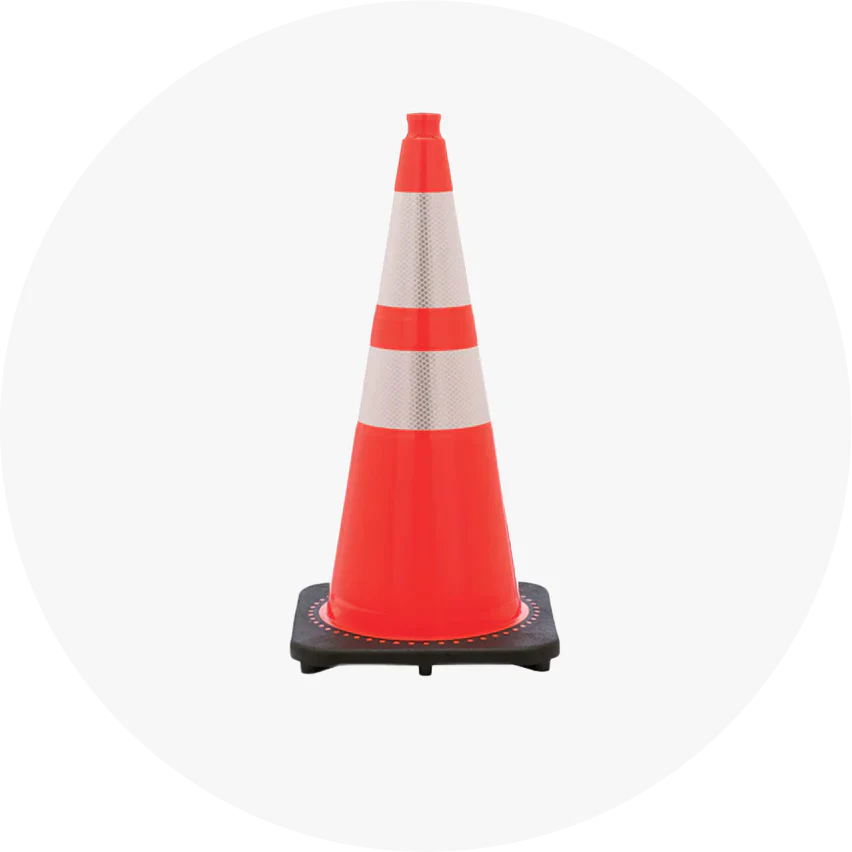





Traffic cone sizes range from small 6-inch training markers to 36-inch and taller roadway devices. For public-road traffic control, the MUTCD specifies an 18-inch minimum for daytime, low-speed conditions and a 28-inch minimum for high-speed highways and nighttime use.
Six-inch and 12-inch cones are primarily used for sports, training, and facility marking. Eighteen-inch cones may suit specified low-speed roadway applications, while 28-inch and 36-inch cones provide greater visibility for construction zones and traffic management.
However, height is only one factor. Base weight, reflective collars, material, road speed, and local transportation requirements determine whether a cone is appropriate.
Understanding these differences helps prevent undersized equipment, poor visibility, and unstable traffic control layouts.
Traffic Cone Size Chart: Heights, Weights, and Common Uses
Traffic cones are commonly available in 6, 12, 18, 28, and 36-inch sizes. Smaller cones serve controlled environments, while taller cones are used where approaching drivers need greater visibility.
|
Cone size |
Height |
Typical weight or base |
Common applications |
|
6 inches |
152 mm |
Lightweight; model-specific |
Sports, drills, indoor marking |
|
12 inches |
305 mm |
Approximately 1–1.5 lb |
Warehouses, training, facilities |
|
18 inches |
457 mm |
Approximately 2.3–4 lb |
Daytime, low-speed roadway work |
|
28 inches |
711 mm |
Common base options: 5.5–10 lb |
Road construction, utility work |
|
36 inches |
914 mm |
Often 10 lb or more; varies |
Larger work zones, exposed sites |
Weights are illustrative product configurations, not federal requirements. Dimensions and actual weights vary by manufacturer.
For a comparison of commercially available sizes and reflective configurations, the Traffic cones collection includes 6, 12, 28, and 36-inch options.
What Are 6-Inch Traffic Cones Used For?
Six-inch traffic cones are compact markers used for sports training, physical education classes, and controlled indoor activities. They are not suitable substitutes for regulated roadway traffic control cones.
Their small size allows coaches to arrange agility drills, obstacle courses, and training boundaries without using full-size equipment.
Unlike flat disc cones, conventional 6-inch cones have an upright tapered body. This makes the marker visible above the floor surface.
In warehouses, they may help identify temporary indoor areas where larger devices would obstruct limited space.
However, their reduced height makes them difficult for approaching vehicle drivers to recognize. They do not meet MUTCD minimum cone heights for roadway use.
When Should You Use 12-Inch Traffic Cones?
Twelve-inch cones are commonly used for temporary marking in warehouses, retail facilities, schools, and indoor pedestrian areas.
Their size provides greater visibility than 6-inch markers while remaining relatively easy to carry and store.
Facility teams may position these cones near maintenance areas, loading zones, or temporary pedestrian restrictions.
Some 12-inch models include weighted bases or reflective collars, although specifications vary.
A reflective collar does not make an undersized cone suitable for public-road traffic control.
For roadway applications governed by MUTCD Section 6K.03, a 12-inch cone does not satisfy the specified minimum heights.
Are 18-Inch Traffic Cones Suitable for Roadwork?
Eighteen-inch cones meet the MUTCD minimum height for daytime traffic control on low-speed roadways.
They may be used during suitable road maintenance, utility operations, and temporary lane restrictions when the traffic control plan permits.
These cones are also commonly associated with parking lots, driveways, and school traffic management.
However, 18-inch cones are not sufficient for the roadway conditions where the MUTCD specifies a 28-inch minimum.
This includes freeway and other high-speed highway applications and nighttime operations on highways.
When greater conspicuity is necessary, the minimum height also increases to 28 inches.
Before selecting 18-inch cones, check the operating conditions and state DOT requirements.
Why Are 28-Inch Traffic Cones Commonly Used for Roadwork?
Twenty-eight-inch traffic cones are a common work-zone size because they meet the MUTCD minimum height for high-speed highways and nighttime roadway use.
Their taller bodies are more recognizable than smaller cones when viewed from approaching vehicles.
They are used during road construction, utility maintenance, lane restrictions, and temporary traffic guidance.
Reflective Markings on 28-Inch Cones
For nighttime retroreflectorization, MUTCD Section 6K.03 specifies two white bands on cones measuring 28–36 inches:
-
A 6-inch band positioned 3–4 inches from the top.
-
A 4-inch band positioned approximately 2 inches below the first.
The required nighttime visibility can also be provided through lighting devices as specified by the MUTCD.
Base Weight and Stability
Common commercial 28-inch configurations include 5.5 lb, 7 lb, and 10 lb bases.
Heavier bases may improve resistance to tipping, but stability also depends on footprint, wind exposure, and passing traffic.
A 7 lb base should not be treated as a universal MUTCD requirement.
When Are 36-Inch Traffic Cones Necessary?
Thirty-six-inch traffic cones provide additional height where greater visibility is desirable or required by project specifications.
They may be used on highways, larger construction sites, exposed roadways, and areas with long approaching sight distances.
Compared with a 28-inch cone, the taller body increases the visible profile. However, height alone does not determine wind resistance.
The base footprint, ballast, body shape, and installation conditions remain important.
For nighttime retroreflectorization, 36-inch cones follow the same two-band arrangement specified for 28–36-inch cones.
Some transportation agencies require particular cone heights or base weights for specific facilities.
There is no universal federal rule requiring 36-inch cones simply because a roadway exceeds a particular speed.
What About Cones Taller Than 36 Inches?
Traffic cones taller than 36 inches follow different MUTCD retroreflective marking requirements.
They use alternating horizontal orange-and-white retroreflective stripes, generally 4–6 inches wide, with additional positioning requirements.
These taller devices should be evaluated against the intended roadway application and agency specifications.
Traffic Cone Sizes and MUTCD Requirements: Myths vs. Facts
The Manual on Uniform Traffic Control Devices establishes minimum dimensions and visibility requirements, not a universal cone size for every situation.
|
Common claim |
What the MUTCD specifies |
|
Every road cone must be 28 inches |
18 inches is permitted for daytime, low-speed roadway conditions |
|
18-inch cones can be used on every street |
High-speed and nighttime highway applications require at least 28 inches |
|
Every 28-inch cone needs reflective collars |
Nighttime cones must be retroreflectorized or equipped with lighting devices |
|
All highways require 36-inch cones |
The federal minimum is 28 inches in the specified conditions |
|
Colored sports cones can replace roadway cones |
Roadway traffic control cones must be predominantly orange |
Section 6K.03 does not establish one fixed base-weight requirement.
State DOTs and project specifications may impose additional conditions.
Official reference: FHWA MUTCD, 11th Edition with Revision 1.
How Do You Choose the Right Traffic Cone Size?
Choose traffic cone height according to roadway access, operating conditions, and the visibility required by approaching drivers.
Three questions help narrow the selection.
Is the Location a Public Road or Private Facility?
Public-road traffic control generally follows applicable MUTCD and transportation-agency requirements.
Private facilities may use smaller cones for controlled pedestrian or equipment areas. However, some privately owned roads open to public travel are also subject to MUTCD requirements.
Will the Cones Be Used During Daylight or Darkness?
Nighttime highway traffic control requires cones at least 28 inches tall, with the required retroreflectivity or lighting.
Indoor and daytime facility applications may use smaller devices when appropriate.
What Are the Traffic and Weather Conditions?
Faster traffic, poor sight distance, wind, and passing heavy vehicles increase the importance of cone visibility and stability.
For practical examples across different environments, see Best Traffic Cones for Parking Lots, Warehouses & Job Sites.
How Do Base Weight and Storage Change with Cone Size?
Larger cones often require more substantial bases because increased height creates greater exposure to wind and passing vehicle turbulence.
However, weight alone does not determine stability. A wider footprint and lower center of gravity also matter.
Most conventional traffic cones have tapered bodies that allow nesting during transport and storage.
Slim-line designs may reduce storage space, while weighted bases increase the total load carried by work vehicles.
Before selecting equipment, compare the full cone dimensions, assembled weight, and available storage capacity.
Frequently Asked Questions
What is the most common traffic cone size?
Twenty-eight-inch cones are widely used for road construction and utility work. Their height meets the MUTCD minimum for high-speed and nighttime highway applications, although reflective requirements and local specifications must also be satisfied.
Are 18-inch cones allowed on public roads?
Yes. The MUTCD permits cones at least 18 inches tall for daytime use on low-speed roadways. High-speed highways, nighttime highway operations, and conditions requiring greater visibility have a 28-inch minimum.
Do 28-inch traffic cones need reflective collars?
For nighttime use, cones must be retroreflectorized or equipped with lighting devices. When using retroreflective bands on 28-inch cones, the MUTCD specifies one 6-inch white band and one 4-inch white band.
Are 36-inch cones required on highways?
Not universally. The federal MUTCD specifies a 28-inch minimum for freeways and other high-speed highways. Individual transportation agencies or project specifications may require taller devices.
What are 6-inch traffic cones used for?
Six-inch cones are primarily used for sports drills, agility training, physical education, and indoor marking. Their small height makes them unsuitable as substitutes for required public-road traffic control cones.
How much does a 28-inch traffic cone weigh?
Weight varies by manufacturer and base configuration. Common commercial models feature 5.5 lb, 7 lb, or 10 lb bases. Check whether the listed weight refers to the base alone or the complete cone assembly.
Conclusion
Traffic cone height should match the operating environment. Six-inch and 12-inch cones suit controlled training and facility applications, while 18-inch cones meet specified daytime, low-speed roadway requirements.
For high-speed and nighttime highway use, the MUTCD establishes a 28-inch minimum. Thirty-six-inch cones provide additional height where appropriate.
Always consider reflective markings, base stability, and local traffic control requirements alongside cone size.