
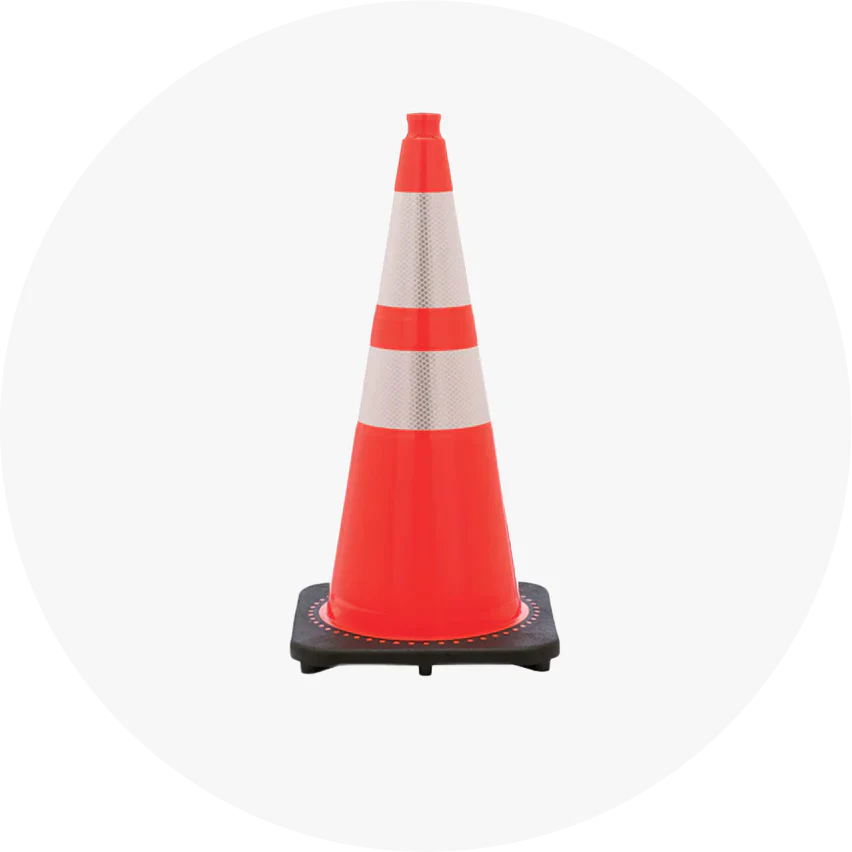






Traffic barricades are temporary traffic control devices used to warn road users, guide vehicles around work areas, and identify roadway closures. The correct barricade depends on its intended function, roadway conditions, visibility requirements, and applicable traffic control standards.
Type I and Type II barricades are primarily used to guide or restrict moving traffic, while Type III barricades are commonly used for full and partial road closures. Their construction, reflective markings, and placement requirements differ.
Choosing the wrong type can reduce visibility, create traffic confusion, or fail to meet project specifications.
This guide explains the differences between traffic barricades, their materials, MUTCD requirements, reflective markings, and the factors that determine which design is appropriate.
What Are Traffic Barricades?
Traffic barricades are portable or temporary devices that communicate restrictions, identify hazards, and guide road users through or around work zones.
They are commonly used during road construction, utility maintenance, pavement repairs, lane restrictions, and temporary road closures.
A typical barricade consists of horizontal rails supported by legs or another approved support system. The rails display alternating orange-and-white retroreflective stripes.
The Manual on Uniform Traffic Control Devices (MUTCD) establishes national standards for traffic control devices on public roads in the United States.
Barricades must be selected and positioned according to the applicable requirements and the temporary traffic control plan.
What Is the Difference Between Type I, Type II, and Type III Barricades?
The main difference between Type I, Type II, and Type III barricades is the number of horizontal rails and their intended traffic control function.
Each type communicates a restriction or warning, but the appropriate application depends on the roadway layout.
|
Feature |
Type I |
Type II |
Type III |
|
Horizontal rails |
One |
Two |
Three |
|
Minimum rail length |
24 inches |
24 inches |
48 inches |
|
Rail width |
8–12 inches |
8–12 inches |
8–12 inches |
|
Primary application |
Traffic guidance |
Traffic guidance |
Road closures |
|
Typical design |
Portable A-frame |
Two-rail frame |
Three-rail frame |
Type I Barricades
A Type I barricade is a single-rail traffic control device used to warn and guide road users around temporary restrictions.
Its compact design is commonly associated with utility work, maintenance areas, and locations where vehicles continue moving through the work zone.
Type I barricades are not normally used as the primary device across a complete roadway closure.
Type II Barricades
A Type II barricade has two horizontal rails, providing a larger marked surface than a Type I device.
The additional rail increases the visible warning area, making Type II barricades useful for traffic channelization and temporary restrictions.
Type II barricades are often considered where operating conditions require greater conspicuity.
However, the number of rails alone does not determine whether the device is appropriate for a particular road speed or application.
Type III Barricades
A Type III barricade has three horizontal rails and is commonly used to identify complete or partial roadway closures.
Its larger structure creates a more prominent visual restriction across the roadway.
Type III barricades may be positioned across closed lanes or roads, with appropriate advance warning signs and detour information.
The exact arrangement depends on the road closure plan, roadway width, and permitted access.
What Is the Difference Between a Traffic Barricade and a Traffic Barrier?
Traffic barricades and traffic barriers serve different safety functions.
A barricade communicates a warning or restriction. A traffic barrier is designed to contain or redirect a vehicle when installed in an approved configuration.
For example, a Type III barricade identifies a road closure but does not provide positive protection against vehicle intrusion.
A crash-tested concrete or approved temporary barrier system may provide that protection.
Similarly, some plastic water-filled devices are intended for traffic channelization rather than vehicle containment.
Therefore, a water-filled product should not be considered crash-rated without documentation for its exact design and installation.
What Does the MUTCD Require for Traffic Barricades?
The MUTCD establishes requirements for barricade construction, rail dimensions, markings, and application.
The 11th Edition, including its applicable revisions, provides the federal framework for temporary traffic control devices.
Under Section 6K.07, traditional barricades use alternating orange-and-white retroreflective stripes.
The stripes slope downward at approximately 45 degrees toward the direction road users should pass.
Rail faces directed toward approaching traffic must be retroreflective.
The standard also establishes minimum rail lengths, rail widths, and other design requirements.
State departments of transportation may adopt additional specifications or project-specific requirements.
Consequently, meeting the basic rail dimensions does not automatically establish that a barricade is suitable for every roadway application.
How Do You Choose the Right Traffic Barricade?
The correct barricade is determined by its traffic control purpose, roadway environment, operating conditions, and required performance.
Six factors are particularly important.
1. Traffic Control Purpose
First, determine whether vehicles will continue moving through the work zone or the road will close.
Type I and Type II barricades commonly help guide traffic through restrictions.
Type III barricades are more appropriate for identifying road closures.
2. Roadway Speed and Traffic Volume
Vehicle speed influences how early drivers must recognize traffic control devices.
Higher-speed roads require careful consideration of visibility, placement, and approved device specifications.
Use the applicable MUTCD provisions and state transportation requirements rather than selecting a barricade based on appearance alone.
3. Daytime or Nighttime Operations
Nighttime operations require devices that remain visible under vehicle headlights.
Retroreflective sheeting returns light toward its source, improving recognition of barricade markings.
Some applications also require warning lights or other supplemental traffic control devices.
4. Material and Construction
Barricades may use high-density polyethylene (HDPE), wood, steel, or combinations of these materials.
The material affects handling weight, weather resistance, maintenance, and durability.
However, material type does not independently establish crashworthiness.
5. Wind and Surface Conditions
Wind, uneven pavement, slopes, and passing vehicle turbulence can affect barricade stability.
The support design and approved ballast must suit the installation conditions.
Avoid unapproved weights or mounting methods that could create additional hazards.
6. Project Specifications
Temporary traffic control plans may specify barricade dimensions, reflective sheeting, approved models, and other requirements.
Before selecting equipment, review the relevant state DOT standards and permit conditions.
Plastic vs. Wood vs. Steel Traffic Barricades
Plastic, wood, and steel barricades differ in construction and maintenance requirements.
No single material is appropriate for every project.
|
Material |
Main advantages |
Limitations |
|
HDPE plastic |
Corrosion resistance, lighter handling, no splintering |
May require appropriate ballast and support |
|
Wood |
Replaceable boards, straightforward construction |
Weathering, splintering, repainting |
|
Steel |
Durable structural components |
Higher weight, potential corrosion |
Plastic barricades are useful where repeated handling and relocation are important.
Wooden barricades may suit applications where damaged boards can be replaced individually.
Steel components are often used when structural durability and repeated use are priorities.
The final selection should account for the complete device design and relevant crashworthiness documentation.
Why Is Reflective Sheeting Important on Traffic Barricades?
Retroreflective sheeting helps drivers identify barricades at night by returning headlight illumination toward the vehicle.
Traffic barricade markings typically use alternating orange-and-white stripes.
Reflective materials vary in performance, construction, and durability.
ASTM D4956 provides classifications and performance requirements for retroreflective sheeting used in traffic control applications.
Common commercial descriptions include Engineering Grade, High-Intensity Prismatic, and Diamond Grade.
However, these names should not be treated as interchangeable with specific ASTM types without checking manufacturer documentation.
The required sheeting depends on the traffic control plan and applicable transportation standards.
Do Traffic Barricades Need Warning Lights?
Warning lights are supplemental traffic control devices used to improve warning or guidance in specified conditions.
They do not replace required barricade markings.
The MUTCD identifies several warning light categories:
-
Type A: Low-intensity flashing warning lights used for selected hazard-warning applications.
-
Type B: High-intensity flashing warning lights used where stronger daytime warning is appropriate.
-
Type C: Steady-burning warning lights commonly associated with delineation.
The appropriate light depends on the work zone layout and relevant specifications.
Not every barricade requires an attached warning light.
Are Traffic Barricades Crashworthy?
Some temporary traffic control barricades have been evaluated for crashworthiness under established testing procedures.
The American Association of State Highway and Transportation Officials (AASHTO) publishes the Manual for Assessing Safety Hardware (MASH).
MASH establishes procedures for evaluating roadside safety hardware during vehicle impacts.
Older traffic control devices may have documentation based on NCHRP Report 350.
The Federal Highway Administration (FHWA) maintains eligibility letters for specific tested roadside hardware.
A crashworthiness evaluation applies to the documented device configuration.
Changing supports, attachments, mounted signs, or structural components may affect whether the installed assembly matches the tested design.
Importantly, a crashworthy barricade is not the same as a positive-protection traffic barrier.
How Should Traffic Barricades Be Stabilized?
Traffic barricades must remain stable under expected placement conditions while following their approved installation requirements.
Depending on the model, stability may depend on support legs, weighted bases, or approved ballast.
Sandbags should be positioned only as permitted by the manufacturer and relevant agency guidance.
Loose rocks, concrete debris, and improvised weights should not be substituted for approved ballast.
Inspecting connections, support legs, and reflective surfaces is also important during ongoing work zone operations.
How Many Traffic Barricades Are Needed for a Road Closure?
The number of barricades depends on roadway width, usable device length, closure layout, and access requirements.
For a simplified example, consider a road measuring 36 feet across and Type III barricade sections covering 8 feet each.
Dividing 36 by 8 gives 4.5 sections.
Rounding upward produces an initial estimate of five barricades.
However, actual installations must account for device spacing, shoulders, support legs, and the approved road closure design.
The temporary traffic control plan determines the final arrangement.
What Are the Most Common Traffic Barricade Mistakes?
Common mistakes include selecting equipment without reviewing its intended function or required specifications.
These problems can affect installation, visibility, and equipment suitability.
-
Using Type I or Type II devices where a Type III road closure is required.
-
Assuming a traffic barricade provides vehicle-impact protection.
-
Selecting reflective sheeting without checking project requirements.
-
Overlooking necessary warning lights or approved supports.
-
Adding signs or accessories outside the documented configuration.
-
Ignoring local DOT specifications and traffic control plans.
The most effective prevention is reviewing the entire device configuration before deployment.
Frequently Asked Questions
Which barricade is used for road closures?
Type III barricades are commonly used for complete or partial road closures. Their three horizontal rails provide a prominent visual restriction, while the approved traffic control plan determines placement, signage, and access requirements.
Can Type II barricades be used on high-speed roads?
Type II barricades may be used in suitable traffic control applications, subject to the applicable roadway standards. Their use depends on the traffic control function, visibility requirements, and approved layout rather than road speed alone.
What does MASH mean for traffic barricades?
MASH stands for Manual for Assessing Safety Hardware. It establishes crash-testing procedures for roadside safety equipment. Testing documentation must identify the exact barricade design and configuration evaluated.
Which direction should barricade stripes face?
Barricade stripes generally slope downward toward the direction traffic should pass. The MUTCD provides detailed marking rules, including requirements for roadway closures and situations where traffic may pass on either side.
Are plastic barricades better than wooden barricades?
Plastic barricades resist corrosion and splintering, while wooden barricades may offer straightforward board replacement. The appropriate choice depends on device design, handling requirements, maintenance conditions, and project specifications.
Are warning lights required on every barricade?
No. Warning lights are required or recommended according to the specific application and traffic control requirements. Every barricade does not automatically need a mounted light.
Are water-filled barricades crash-rated?
Not necessarily. Many water-filled devices are designed for traffic channelization. Vehicle-impact protection requires verified testing and an approved system configuration.
Final Thoughts
Choosing the appropriate traffic barricade starts with understanding its function.
Type I and Type II barricades commonly guide traffic through temporary restrictions, while Type III barricades identify roadway closures.
Material, reflective sheeting, warning lights, crashworthiness documentation, and proper installation also influence the selection.
For an overview of available designs and configurations, the Traffic Barricades collection provides a useful reference alongside the applicable MUTCD and project specifications.