
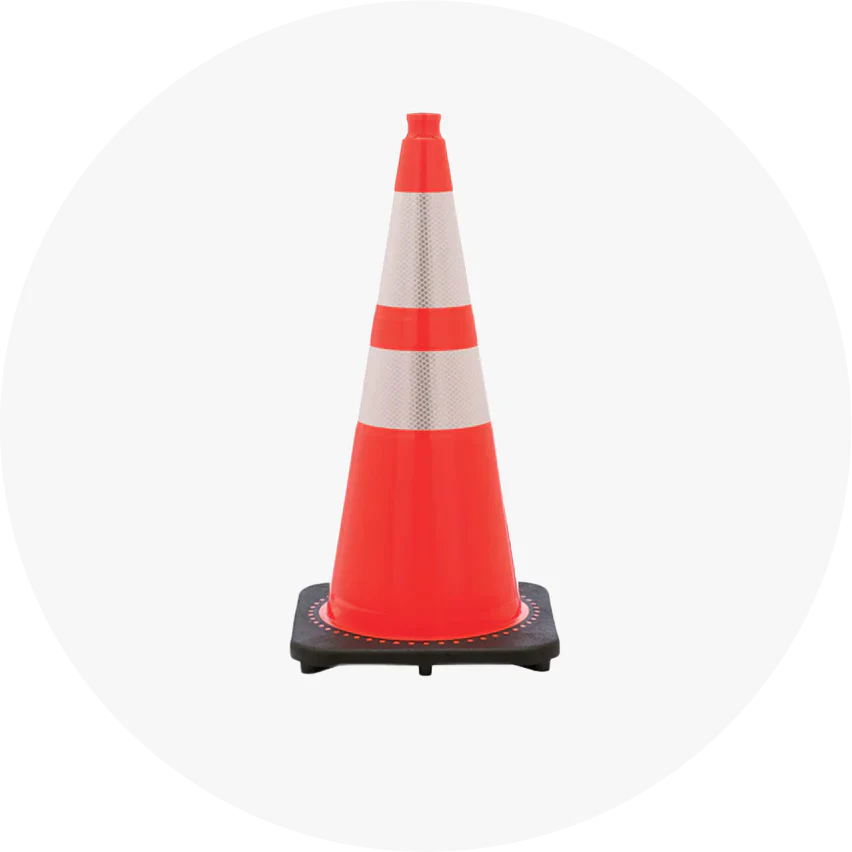

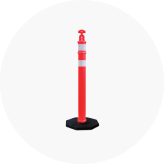




MUTCD traffic cone requirements specify predominantly orange cones, a minimum height of 18 inches for daytime low-speed roadway use, and at least 28 inches for freeways, high-speed highways, and nighttime highway operations. Cones used at night must also be retroreflectorized or equipped with lighting devices.
For 28- to 36-inch cones, the required retroreflective pattern consists of two white bands measuring 6 inches and 4 inches wide.
These rules appear in Section 6K.03 of the Manual on Uniform Traffic Control Devices (MUTCD), published by the Federal Highway Administration (FHWA).
The requirements establish federal minimums. State departments of transportation, roadway authorities, and project specifications may impose additional conditions.
MUTCD Traffic Cone Requirements at a Glance
MUTCD Section 6K.03 establishes traffic cone design and visibility requirements for temporary traffic control. Cone height, color, construction, and nighttime markings depend on the roadway application.
|
Requirement |
Federal MUTCD rule |
|
Color |
Predominantly orange |
|
Construction |
Material that can be struck without damaging vehicles |
|
Daytime, low-speed roads |
Minimum 18-inch height |
|
Freeways and high-speed highways |
Minimum 28-inch height |
|
Nighttime highway use |
Minimum 28-inch height |
|
Nighttime visibility |
Retroreflectorization or lighting devices |
|
Reflective bands, 28–36 inches |
One 6-inch and one 4-inch white band |
|
Cones taller than 36 inches |
Alternating orange-and-white retroreflective stripes |
The table summarizes federal requirements, not every condition affecting an installation.
When comparing equipment, check the dimensions and reflective configurations of available Traffic cones against the applicable project specifications.
Which MUTCD Edition Covers Traffic Cones?
The current federal manual is the MUTCD 11th Edition with Revision 1, dated December 2025. Revision 1 became effective on March 5, 2026.
Traffic cones are addressed in Section 6K.03, within Part 6 covering temporary traffic control.
Older references may identify Section 6F.64 from the 2009 edition. That numbering should not be used when citing the current manual.
The MUTCD establishes national standards under 23 CFR Part 655, Subpart F.
State adoption, approved supplements, and project-specific requirements must also be considered.
Official reference: FHWA MUTCD, 11th Edition with Revision 1.
What Do Shall, Should, and May Mean in the MUTCD?
The MUTCD distinguishes mandatory requirements from recommended and optional practices.
Standard: Uses shall to identify a mandatory requirement.
Guidance: Uses should to describe a recommended practice, with deviations permitted when justified by engineering judgment or study.
Option: Uses may to identify a permitted practice.
Support: Provides explanatory information without establishing a requirement.
This distinction matters when interpreting cone height, reflective markings, ballast, and installation recommendations.
A recommended practice should not be presented as a universal federal mandate.
What Color Must MUTCD Traffic Cones Be?
Traffic cones used for temporary traffic control must be predominantly orange.
Section 6K.03 establishes this requirement to maintain a recognizable appearance for roadway channelizing devices.
Orange cones are distinguishable from many permanent traffic control features and other temporary markers.
The required nighttime retroreflective markings introduce white bands or stripes.
Other colors, including green, blue, yellow, and pink, may serve particular purposes in warehouses, sports facilities, or private events.
However, these colors should not replace predominantly orange traffic cones where MUTCD requirements apply.
What Is the Minimum MUTCD Traffic Cone Height?
The MUTCD establishes two principal minimum cone heights based on roadway conditions.
When Are 18-Inch Traffic Cones Allowed?
Cones must be at least 18 inches tall when used during daytime operations on low-speed roadways.
This minimum applies only when the roadway and operating conditions satisfy the relevant requirements.
A private parking lot may have different operating considerations, but roads open to public travel can still fall within MUTCD scope.
When Are 28-Inch Traffic Cones Required?
Traffic cones must be at least 28 inches tall when used:
-
On freeways.
-
On other high-speed highways.
-
On highways during nighttime operations.
-
Where more conspicuous guidance is needed.
A taller cone increases the visible profile, but the installation must still satisfy applicable marking and placement requirements.
Does the MUTCD Require 36-Inch Cones?
The federal MUTCD does not establish a general 36-inch minimum for highways.
However, state transportation agencies and individual projects may specify 36-inch cones.
Consequently, a 28-inch cone meeting federal minimum dimensions may not satisfy a stricter contract specification.
What Are the MUTCD Reflective Collar Requirements?
Traffic cones used at night must be retroreflectorized or equipped with lighting devices.
Retroreflective sheeting redirects incident light toward its source, helping drivers recognize cones under vehicle headlights.
Reflective Bands for 28–36-Inch Cones
For cones measuring 28 to 36 inches, Section 6K.03 specifies:
-
One 6-inch-wide white band positioned 3–4 inches below the top.
-
A second 4-inch-wide white band positioned approximately 2 inches below the first.
A cone exactly 36 inches tall follows this two-band configuration.
Reflective Markings Above 36 Inches
Cones taller than 36 inches require alternating orange-and-white retroreflective stripes.
The stripes are 4–6 inches wide, with at least two orange and two white stripes.
The uppermost stripe must be orange, and the maximum unreflectorized gap is 3 inches.
Do 18-Inch Cones Need Reflective Collars?
Section 6K.03 does not establish the same two-band arrangement for cones under 28 inches.
However, an 18-inch cone cannot substitute for the required 28-inch minimum during nighttime highway use.
Reflective material specifications may also vary by transportation agency.
What Materials and Stability Requirements Apply?
The MUTCD requires traffic cones to be manufactured from materials that can be struck without damaging the impacting vehicle.
Flexible polyvinyl chloride (PVC) and polyethylene are commonly used in cone construction, while rubber may be used in weighted bases.
Material selection alone does not establish suitability for a particular roadway.
Cones should remain upright under expected operating conditions.
Base dimensions, weight, wind exposure, and turbulence from passing vehicles all influence stability.
The MUTCD provides guidance on minimizing blow-over and permits certain stabilization approaches. Ballast should remain limited to the amount needed.
Follow manufacturer instructions and agency requirements rather than adding improvised weights.
Crashworthiness claims under MASH or NCHRP Report 350 must be checked against the exact product documentation.
What Does the MUTCD Not Specify About Traffic Cones?
The federal MUTCD does not establish a universal cone base weight, commercial reflective sheeting grade, or one fixed speed threshold for every cone application.
|
Common specification |
Who determines it? |
|
Minimum base weight |
State DOT, agency, or project |
|
Reflective sheeting grade |
Applicable agency specifications |
|
Particular approved product models |
Roadway authority or project |
|
Additional cone height requirements |
State or project specifications |
|
Site-specific cone spacing |
Temporary traffic control plan |
For example, a transportation agency may require heavier bases or a particular ASTM D4956 retroreflective sheeting classification.
Those requirements should be attributed to the relevant agency rather than presented as nationwide MUTCD rules.
For broader equipment-selection considerations, see our Traffic Cone Buying Guide.
Does OSHA Have Separate Traffic Cone Requirements?
OSHA does not establish an independent set of traffic cone height and reflective collar dimensions equivalent to MUTCD Section 6K.03.
Under 29 CFR 1926.200(g)(2), traffic control devices used to protect construction workers must conform to the MUTCD provisions incorporated by OSHA.
Therefore, construction employers must consider both occupational safety obligations and applicable roadway traffic control requirements.
The current FHWA edition and the editions incorporated by OSHA should not be assumed legally identical.
Official reference: OSHA 29 CFR 1926.200.
Common Myths About MUTCD Traffic Cone Requirements
Several common assumptions confuse federal minimums with state or project-specific requirements.
|
Myth |
Correct explanation |
|
Every roadway cone must be 28 inches |
18 inches is permitted for daytime, low-speed use |
|
All highways require 36-inch cones |
The specified federal minimum is generally 28 inches |
|
A single reflective collar is enough for 28-inch cones |
The prescribed band pattern uses 6-inch and 4-inch bands |
|
Every cone needs a 7 lb base |
No universal federal base weight is specified |
|
OSHA establishes separate cone dimensions |
OSHA references MUTCD traffic control provisions |
|
Colored facility cones automatically meet MUTCD requirements |
Roadway cones must be predominantly orange |
Understanding these distinctions helps prevent incorrect interpretations of equipment specifications.
How Do You Keep Traffic Cones Suitable for Roadway Use?
Traffic cones must remain visible, stable, and serviceable during their use.
Repeated handling, vehicle contact, weather exposure, and accumulated dirt can damage cone bodies or reflective markings.
Inspect equipment for:
-
Faded orange surfaces.
-
Cracked or permanently deformed bodies.
-
Broken or separated weighted bases.
-
Peeling or damaged retroreflective bands.
-
Dirt or asphalt residue obscuring reflective surfaces.
Damaged devices that no longer satisfy the applicable requirements should be replaced.
Nighttime inspections can also reveal reduced retroreflectivity that is difficult to identify during daylight.
Frequently Asked Questions
What height traffic cone does the MUTCD require at night?
The MUTCD requires traffic cones to be at least 28 inches tall when used on highways at night. They must also be retroreflectorized or equipped with lighting devices.
Does the MUTCD require 36-inch traffic cones on highways?
No universal federal requirement mandates 36-inch cones on all highways. The MUTCD specifies a 28-inch minimum for freeways, other high-speed highways, and nighttime highway operations.
Do 18-inch traffic cones need reflective collars?
The MUTCD does not specify the 28–36-inch two-band pattern for 18-inch cones. However, 18-inch cones do not satisfy the minimum height for nighttime highway traffic control.
What are the MUTCD reflective collar dimensions?
For 28–36-inch cones, the MUTCD specifies a 6-inch white band positioned 3–4 inches below the top and a 4-inch white band approximately 2 inches beneath it.
What color must traffic cones be?
Traffic cones used for roadway temporary traffic control must be predominantly orange. White retroreflective markings are required where the specified nighttime band or stripe configurations apply.
Does OSHA have its own traffic cone requirements?
OSHA's construction regulations reference MUTCD traffic control requirements rather than establishing separate cone dimensions. Employers must follow applicable occupational safety and roadway traffic control rules.
Can companies print their names on traffic cones?
Manufacturer and ownership markings may be permitted subject to MUTCD restrictions and agency requirements. They must not obscure required orange surfaces or retroreflective markings.
Conclusion
MUTCD traffic cone requirements establish minimum standards for color, height, construction, and nighttime visibility.
For high-speed and nighttime highway operations, the key federal requirements include predominantly orange cones, at least 28 inches of height, and appropriate retroreflective markings or lighting.
These are federal minimums. Always confirm your state MUTCD, transportation agency's approved-products list, and project specifications before selecting or deploying traffic cones.