
 ConesBulk pricing
 Hard HatsAdd your logo
 Hi-VisAdd your logo


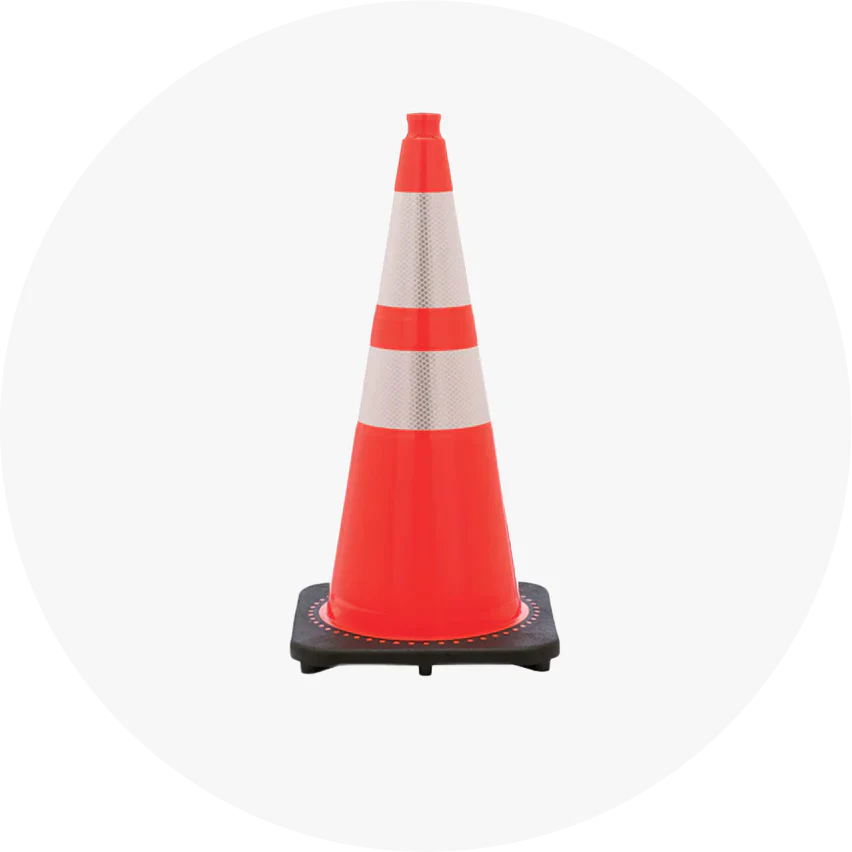





OSHA barricade requirements direct construction employers to the Manual on Uniform Traffic Control Devices (MUTCD) for the design and use of barricades protecting workers from traffic hazards. OSHA does not establish separate dimensions for Type I, Type II, or Type III traffic barricades.
Under 29 CFR 1926.200(g)(2), construction traffic control devices must conform to Part 6 of the MUTCD incorporated by OSHA.
The MUTCD establishes requirements for barricade types, rail dimensions, retroreflective markings, and work-zone applications. Crashworthiness, pedestrian accessibility, and state transportation specifications introduce additional considerations.
Understanding how these requirements interact helps contractors select appropriate devices and document their use.
OSHA and MUTCD Barricade Requirements at a Glance
OSHA establishes construction worker protection obligations, while the MUTCD provides technical traffic control specifications. Crashworthiness and pedestrian accessibility must also be evaluated where applicable.
|
Authority |
Main requirement |
Reference |
|
OSHA |
Traffic control at construction hazard points |
29 CFR 1926.200(g) |
|
MUTCD |
Barricade design, markings, and applications |
Section 6K.07 |
|
FHWA/AASHTO |
Crashworthiness evaluation |
MASH and applicable policies |
|
ADA accessibility requirements |
Accessible pedestrian routes |
ADA standards and MUTCD provisions |
|
State DOT |
Additional specifications and acceptance requirements |
State manuals and contracts |
For examples of the different rail and support configurations, the Traffic Barricades collection illustrates Type I, Type II, and Type III designs.
What Does OSHA Require for Construction Barricades?
OSHA requires construction areas to have appropriate traffic control signs and devices at points of hazard.
Under 29 CFR 1926.200(g)(1), construction areas must have legible traffic control signs and protective traffic control devices where hazards exist.
Section 1926.200(g)(2) requires those devices to conform to the incorporated MUTCD provisions.
This includes barricades, signs, signals, and pavement markings used to protect construction workers.
What Changed in OSHA's 2019 Rule?
On May 14, 2019, OSHA published the Standards Improvement Project, Phase IV.
The rule became effective July 15, 2019, and removed the former 29 CFR 1926.202 barricade section.
Its requirements were consolidated into 1926.200(g), eliminating duplicated provisions.
Which MUTCD Edition Does OSHA Reference?
OSHA incorporates the 2009 MUTCD with Revisions 1 and 2.
FHWA's current federal publication is the 11th Edition with Revision 1, dated December 2025.
These editions should not be treated as interchangeable legal references. Contractors must check the version incorporated by the applicable regulation, together with state and project requirements.
Official reference: OSHA 29 CFR 1926.200.
What Are the MUTCD Requirements for Type I, II, and III Barricades?
The MUTCD classifies conventional traffic barricades by their horizontal rail configuration.
The current federal edition addresses these devices in Section 6K.07.
|
Specification |
Type I |
Type II |
Type III |
|
Horizontal rails |
1 |
2 |
3 |
|
Minimum rail length |
24 inches |
24 inches |
48 inches |
|
Rail width |
8–12 inches |
8–12 inches |
8–12 inches |
|
Common application |
Traffic guidance |
Traffic guidance |
Road closures |
Type I Barricades
Type I barricades have one horizontal rail.
They are used for suitable temporary traffic restrictions and channelization applications.
Their placement depends on the approved traffic control arrangement.
Type II Barricades
Type II barricades have two horizontal rails.
The additional rail provides a larger marked area than a Type I device.
They may be used in suitable work-zone channelization applications but should not automatically replace Type III devices at road closures.
Type III Barricades
Type III barricades have three horizontal rails and commonly identify complete or partial roadway closures.
Their positioning must communicate the restricted route clearly.
The approved closure plan determines placement, warning signs, access arrangements, and the required number of devices.
What Are the MUTCD Barricade Stripe Requirements?
MUTCD Section 6K.07 specifies alternating orange-and-white retroreflective stripes.
The stripes slope downward at 45 degrees toward the direction road users should pass.
The standard stripe width is 6 inches.
For rails shorter than 36 inches, 4-inch stripes are permitted.
Barricades used on freeways, expressways, and other high-speed roadways must provide at least 270 square inches of retroreflective area facing approaching road users.
Reflective material must remain serviceable throughout the installation.
Which Direction Should Barricade Stripes Face?
Stripe orientation indicates the intended direction of travel.
Where drivers pass to the right, stripes slope downward toward the right.
Where traffic passes to the left, the pattern slopes toward the left.
Different arrangements apply when traffic may pass on both sides or when a roadway is completely closed.
The markings must match the intended traffic movement.
Can Signs, Lights, and Ballast Be Attached to Barricades?
Signs, warning lights, and ballast may be used with barricades when permitted by the traffic control plan and the device's approved configuration.
However, attachments can change weight distribution and impact behavior.
Signs
Road closure signs must meet applicable MUTCD requirements.
A sign attached to a barricade should not obscure required markings or exceed permitted mounting limits.
Where appropriate, a separately supported sign can avoid placing additional loads on the barricade frame.
Warning Lights
Type A and Type B warning lights serve different warning functions.
Their use depends on the roadway operation, visibility conditions, and approved traffic control arrangement.
Not every barricade requires an attached light.
Ballast
Ballast helps resist displacement from wind and passing vehicles.
Approved sandbags are generally positioned low on the support system rather than across upper rails.
Follow manufacturer and agency requirements. Improvised concrete blocks or loose debris should not replace approved ballast.
Do Traffic Barricades Have to Be Crashworthy?
Traffic barricades exposed to vehicle traffic must satisfy applicable crashworthiness requirements.
The Manual for Assessing Safety Hardware (MASH), published by AASHTO, establishes crash-testing procedures for roadside safety hardware.
Earlier devices may have been evaluated under NCHRP Report 350.
Under the FHWA/AASHTO implementation framework, temporary work-zone devices manufactured after December 31, 2019, are subject to MASH 2016 testing criteria. Earlier qualified devices may remain usable under applicable service-life and agency policies.
Crashworthiness applies to the documented assembly, not its material alone.
Plastic rails, steel frames, connections, supports, lights, and mounted signs may affect the tested configuration.
An FHWA eligibility letter provides evidence concerning the evaluated hardware. It does not establish universal MUTCD compliance or vehicle containment capability.
A traffic barricade should not be confused with a crash-tested positive-protection barrier.
What Are the Requirements for Pedestrian Barricades?
Pedestrian channelizing devices must provide accessible guidance when temporary construction affects pedestrian routes.
MUTCD Section 6K.02 addresses devices used to channelize pedestrians.
These devices must be detectable to long-cane users and visible to pedestrians with vision disabilities.
Where required, an effective design includes a continuous detection surface near the ground and a hand-trailing surface.
The illustrated MUTCD configuration uses a bottom detection edge no more than 2 inches above the walking surface and a hand-trailing edge approximately 32–38 inches high.
Simple tape, ropes, or chains suspended between cones generally do not provide equivalent cane-detectable guidance.
Pedestrian devices exposed to vehicle traffic must also satisfy applicable crashworthiness requirements.
Accessibility must be considered when designing temporary routes, sidewalk closures, and pedestrian detours.
How Are OSHA Barricade Violations Evaluated?
OSHA evaluates whether required traffic control devices were provided and whether their design and use met the applicable incorporated requirements.
Inspectors may examine the worksite layout, traffic hazards, signage, barricade placement, and available documentation.
A traffic control plan can help establish the intended arrangement, but possession of a plan does not automatically establish compliance.
Contractors should maintain manufacturer specifications, equipment inspection records, and relevant crashworthiness documentation.
Where federal, state, and contract requirements differ, the applicable legal and contractual obligations must be identified.
Common OSHA and MUTCD Barricade Myths
Several widely repeated claims confuse barricade specifications with other construction safety requirements.
|
Myth |
Correct explanation |
|
OSHA requires every Type III barricade to be five feet tall |
OSHA does not establish that universal dimension |
|
Type III barricades must have 48-inch rail height |
The MUTCD specifies a 48-inch minimum rail length |
|
Barricades need a 42-inch top rail |
That dimension relates to certain guardrail requirements |
|
OSHA 1926.202 is still the barricade rule |
The section was removed in 2019 |
|
Reflective stripes alone establish compliance |
Configuration, application, and crashworthiness also matter |
|
Every plastic barricade is crashworthy |
Performance depends on documented testing |
Barricade Compliance Checklist for Contractors
Before installing traffic barricades, confirm:
-
Device type matches the approved traffic control plan.
-
Rails satisfy applicable length and width requirements.
-
Reflective stripe orientation and dimensions are correct.
-
Sheeting remains visible and serviceable.
-
Crashworthiness documentation covers the selected configuration.
-
Signs, warning lights, and ballast follow approved instructions.
-
Pedestrian guidance provides required accessibility features.
-
State DOT specifications and contract requirements have been reviewed.
For a broader discussion of selecting barricades for different environments, see Traffic Barricade Buying Guide.
Frequently Asked Questions
What does OSHA require for traffic barricades?
OSHA requires traffic control signs and devices at construction hazard points. Under 29 CFR 1926.200(g)(2), their design and use must conform to the incorporated MUTCD requirements.
Is OSHA 1926.202 still in effect?
No. OSHA removed 29 CFR 1926.202 in 2019 and consolidated the relevant barricade provisions under 1926.200(g).
Which MUTCD edition does OSHA enforce?
OSHA incorporates the 2009 MUTCD with Revisions 1 and 2. FHWA publishes a newer federal edition, so employers must distinguish the incorporated OSHA reference from current roadway standards.
What is the difference between Type I, II, and III barricades?
Type I barricades have one rail, Type II have two, and Type III have three. Their intended applications and minimum rail lengths differ.
Can a ROAD CLOSED sign be mounted on a Type III barricade?
A ROAD CLOSED sign may be mounted when the configuration satisfies applicable MUTCD, mounting, and crashworthiness requirements. The sign should not obscure required markings or compromise the tested assembly.
Do barricades have to be MASH-tested?
Applicable crashworthiness requirements depend on the device, manufacturing date, deployment context, and roadway authority. Verify whether MASH or earlier accepted testing documentation applies to the exact model.
How should traffic barricades be weighted?
Barricades should use manufacturer-approved supports and ballast arrangements. Ballast should be positioned low and should not introduce additional hazards.
What makes a pedestrian barricade detectable?
A pedestrian channelizing device must provide features detectable by people using long canes. MUTCD Section 6K.02 addresses lower detection surfaces and accessible guidance.
Conclusion
OSHA establishes construction traffic control obligations, the MUTCD defines barricade design and application requirements, and crashworthiness standards address vehicle-impact performance.
Proper compliance requires the correct barricade type, reflective markings, approved installation configuration, and appropriate pedestrian accommodations.
Always confirm the applicable OSHA regulation, state MUTCD or supplement, approved traffic control plan, and contract specifications before deployment.