
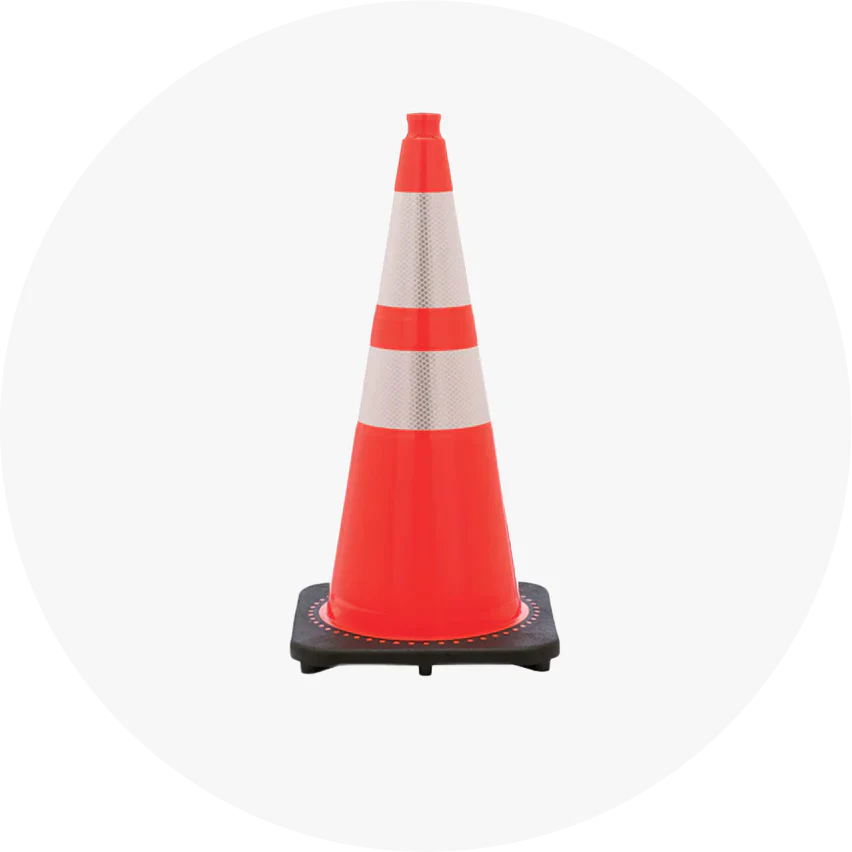





Traffic cones are orange because the Manual on Uniform Traffic Control Devices (MUTCD) assigns orange to temporary traffic control, and the color provides strong visual contrast in many roadway environments. Drivers also recognize orange as a warning of construction, maintenance, or temporary changes in traffic conditions.
The Federal Highway Administration (FHWA) requires traffic cones used for temporary roadway traffic control to be predominantly orange.
However, not every cone is orange. Yellow, blue, green, red, pink, and black cones are also used in warehouses, parking lots, schools, and events.
These alternative colors usually follow workplace safety conventions or local operating procedures rather than federal roadway cone requirements.
Understanding traffic cone colors helps explain where each color belongs and why orange remains the standard for roadwork.
Why Is Orange the Standard Color for Traffic Cones?
Orange is the standard roadway traffic cone color for three reasons: federal requirements, visual contrast, and consistent driver recognition.
1. Orange Identifies Temporary Traffic Control
MUTCD Section 1D.05 assigns orange the meaning of temporary traffic control.
Section 6K.03 specifically requires cones to be predominantly orange.
This creates consistency between traffic cones and other orange temporary traffic control devices, including construction warning signs.
2. Orange Provides Strong Visual Contrast
Bright orange contrasts with many common roadway backgrounds, including gray pavement, vegetation, and roadside structures.
Fluorescent orange materials can provide additional conspicuity under suitable daylight and twilight conditions.
However, visibility depends on lighting, background, material condition, and viewing distance.
3. Orange Is Familiar to Drivers
Consistent use helps drivers associate orange devices with temporary roadway conditions.
A row of orange cones may indicate a lane restriction, maintenance activity, or altered traffic path.
Drivers must still follow the accompanying signs and other traffic control devices.
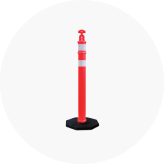
For examples of different colors, heights, and reflective configurations, compare the <Link url="https://safetysuppliesusa.com/collections/traffic-cones">Traffic cones</Link> used for construction, facilities, and temporary marking.
What Does the MUTCD Say About Traffic Cone Colors?
The MUTCD establishes standardized colors for traffic control devices. Section 1D.05 assigns specific meanings to these colors, while Section 6K.03 establishes the requirements for traffic cones.
|
Color |
MUTCD meaning |
Common application |
|
Orange |
Temporary traffic control |
Construction and work zones |
|
Yellow |
Warning |
General roadway warning signs |
|
Red |
Stop or prohibition |
STOP signs and prohibitions |
|
Fluorescent pink |
Incident management |
Incident management signs |
|
Fluorescent yellow-green |
Pedestrian, bicycle, playground, and school-related warnings |
Applicable warning signs |
|
Green |
Permitted movements and direction guidance |
Directional signs |
|
Blue |
Road-user services, tourist information, and evacuation-route guidance |
Service and information signs |
|
Black and white |
Regulation |
Regulatory signs |
Important: These are general MUTCD color meanings, not permission to manufacture roadway cones in every listed color.
For traffic cones themselves, Section 6K.03 requires a predominantly orange body.
The current federal reference is the MUTCD 11th Edition with Revision 1.
Official source: FHWA Manual on Uniform Traffic Control Devices.
Why Is Orange Easier to Notice on Roads?
Orange traffic cones are conspicuous because of their color contrast, saturated appearance, and recognizable shape.
Human color vision responds to different wavelengths of visible light through cone photoreceptors in the retina.
Under normal daylight conditions, human visual sensitivity is greatest around the yellow-green region of the spectrum, not orange.
Therefore, the claim that traffic cones are orange because the human eye is most sensitive to orange is incorrect.
The practical benefit comes from contrast with surrounding objects and consistent use in traffic control.
What Makes Fluorescent Orange Different?
Fluorescent pigments absorb certain wavelengths of light and re-emit part of that energy as visible light.
This can make a fluorescent surface appear especially conspicuous in suitable daylight conditions.
However, fluorescence does not replace retroreflectivity at night.
When vehicle headlights illuminate retroreflective material, that material returns light toward the approaching driver.
This is why nighttime traffic cones require appropriate retroreflective markings or lighting devices.
Who Invented the Traffic Cone?
Charles D. Scanlon, a Los Angeles street department employee, developed an early flexible traffic safety marker in the 1940s.
His design addressed problems with wooden tripods and rigid barriers used around wet road markings and maintenance areas.
Scanlon received U.S. Patent 2,333,273 on November 2, 1943.
The patented design described a hollow, flexible cone with a weighted base. It could be stacked for transportation and was intended to reduce damage when struck by a vehicle.
How Did Traffic Cones Develop?
|
Period |
Development |
|
Early 1940s |
Charles D. Scanlon developed a flexible roadway safety marker |
|
1943 |
U.S. Patent 2,333,273 was granted |
|
Mid-20th century |
Flexible rubber and later plastic designs became more common |
|
Later decades |
Orange became firmly established as a recognizable roadway traffic control color |
|
Today |
Many cones use flexible polymer bodies, weighted bases, and retroreflective markings |
Historical sources disagree about the exact colors used on the earliest commercially produced cones.
The 1943 patent establishes their construction and intended purpose but does not establish that every early cone was orange.
Original reference: U.S. Patent 2,333,273 — Safety Marker.
What Do Different Traffic Cone Colors Mean?
Outside regulated roadway traffic control, cone colors often communicate meanings established by facility procedures, industry practices, or event organizers.
There is no universal federal color code assigning each non-orange traffic cone a specific purpose.
|
Cone color |
Meaning or association |
Basis |
|
Orange |
Temporary roadway traffic control |
MUTCD requirement for cones |
|
Yellow |
Caution and physical hazards |
OSHA workplace color convention |
|
Red |
Danger, stop, or restricted access |
OSHA workplace color convention |
|
Green or lime green |
Site-specific guidance or identification |
Local convention |
|
Blue |
Site-specific parking or operational identification |
Local convention |
|
Pink |
Events, awareness activities, or designated areas |
Local convention |
|
Black or white |
Parking organization, events, or visual identification |
Local convention |
Yellow Traffic Cones
Yellow is associated with caution in industrial settings.
OSHA standard 29 CFR 1910.144 identifies yellow as the basic color for caution and certain physical hazards, including tripping and striking hazards.
However, this does not create a universal requirement that warehouse cones must be yellow.
Red Traffic Cones
Red is commonly associated with danger, stopping, and restricted access.
Under OSHA safety color provisions, red has defined roles in danger identification and emergency stop applications.
A facility may use red cones to support a local restriction, but the cone color alone does not establish a regulatory prohibition.
Blue Traffic Cones
Blue cones may identify designated areas in parking facilities, events, or industrial operations.
Their meaning depends on the organization using them.
Unlike blue roadway service signs, blue traffic cones do not have a universal MUTCD-assigned purpose.
Green and Lime-Green Cones
Green cones are sometimes used to mark pedestrian routes, designated activity areas, or facility-specific operations.
Lime-green cones may be highly visible against particular backgrounds.
However, standard green cones should not replace orange cones in regulated roadway temporary traffic control.
Pink Traffic Cones
Pink cones are often associated with events, promotional activities, and awareness campaigns.
Although the MUTCD assigns fluorescent pink to incident management, that designation does not make pink cones interchangeable with orange roadway cones.
Black and White Traffic Cones
Black and white cones may be used in parking facilities, organized events, or customer-facing environments.
Their meanings depend on the local marking system rather than a universal federal traffic cone classification.
Why Do Websites Give Different Meanings for Cone Colors?
Many websites confuse traffic cone colors with underground utility marking colors, roadway sign colors, or informal workplace practices.
For example, the American Public Works Association (APWA) utility locating color code associates blue with potable water and pink with temporary survey markings.
Those meanings apply to utility location markings, such as paint and flags.
They do not automatically apply to traffic cones.
Similarly, the MUTCD assigns fluorescent pink to incident management signs, not to every pink cone.
Always identify which standard or local procedure establishes a color's meaning.
Which Traffic Cone Color Should You Use?
Choose orange cones for roadway temporary traffic control. For private facilities, select colors that align with established safety procedures and communicate a clear purpose.
|
Application |
Color to consider |
Reason |
|
Public-road construction |
Orange |
MUTCD requirement |
|
Utility work on public roads |
Orange |
Temporary traffic control |
|
Warehouse caution marking |
Yellow |
Established caution association |
|
Facility-specific restricted area |
Red |
Danger or restriction convention |
|
Event organization |
Green, pink, or another designated color |
Site-specific identification |
|
Private parking management |
Orange or designated facility color |
Visibility and operating consistency |
For projects involving vehicle traffic, cone size, reflectivity, and base stability matter as much as color.
Our Traffic Cone Buying Guide explains how to evaluate these specifications for different applications.
When Should Faded Orange Traffic Cones Be Replaced?
Traffic cones should be replaced when fading, damage, or contamination prevents them from providing the intended warning.
Prolonged sunlight exposure can alter pigments and reduce the conspicuity of some polymer surfaces.
Cracks, deformed bases, peeling reflective collars, and accumulated road residue can also reduce performance.
Inspect cones regularly and remove devices that no longer meet applicable agency or manufacturer criteria.
Frequently Asked Questions
Why are traffic cones orange?
Traffic cones are orange because the MUTCD designates orange for temporary traffic control. The color also provides useful contrast against many roadway backgrounds and has become familiar to drivers.
Who invented the traffic cone?
Charles D. Scanlon developed an early flexible roadway safety marker in Los Angeles. His invention received U.S. Patent 2,333,273 on November 2, 1943.
Were traffic cones always orange?
The earliest traffic cone designs were not necessarily orange. Historical accounts differ about their original colors, and Scanlon's 1943 patent does not establish a mandatory orange finish.
What do blue traffic cones mean?
Blue traffic cones generally have meanings assigned by the facility or organization using them. No universal federal roadway cone standard assigns blue cones a specific traffic control function.
What do green traffic cones mean?
Green cones may mark pedestrian areas, designated activity zones, or other locally defined purposes. Their meanings depend on the site rather than a universal roadway traffic cone standard.
Why are warehouse cones often yellow?
Yellow is associated with caution under OSHA workplace safety color provisions. Facilities may use yellow cones for temporary hazards, but OSHA does not require every warehouse cone to be yellow.
Can colored traffic cones be used on public roads?
Traffic cones used for temporary roadway traffic control must be predominantly orange under the MUTCD. Other colors should not replace the required roadway devices without an applicable authorized provision.
Why do traffic cones have white reflective stripes?
White retroreflective markings return vehicle headlight illumination toward approaching drivers. They help make traffic cones visible at night when ordinary body color may be difficult to distinguish.
Conclusion
Traffic cones are orange because federal traffic control standards assign that color to temporary roadway operations. Their visibility also benefits from contrast, fluorescent materials, and consistent driver recognition.
Other cone colors can help organize warehouses, parking facilities, and events, but their meanings are usually local conventions.
For public-road use, orange remains the required color, and the complete cone must meet applicable height, reflectivity, and project specifications.